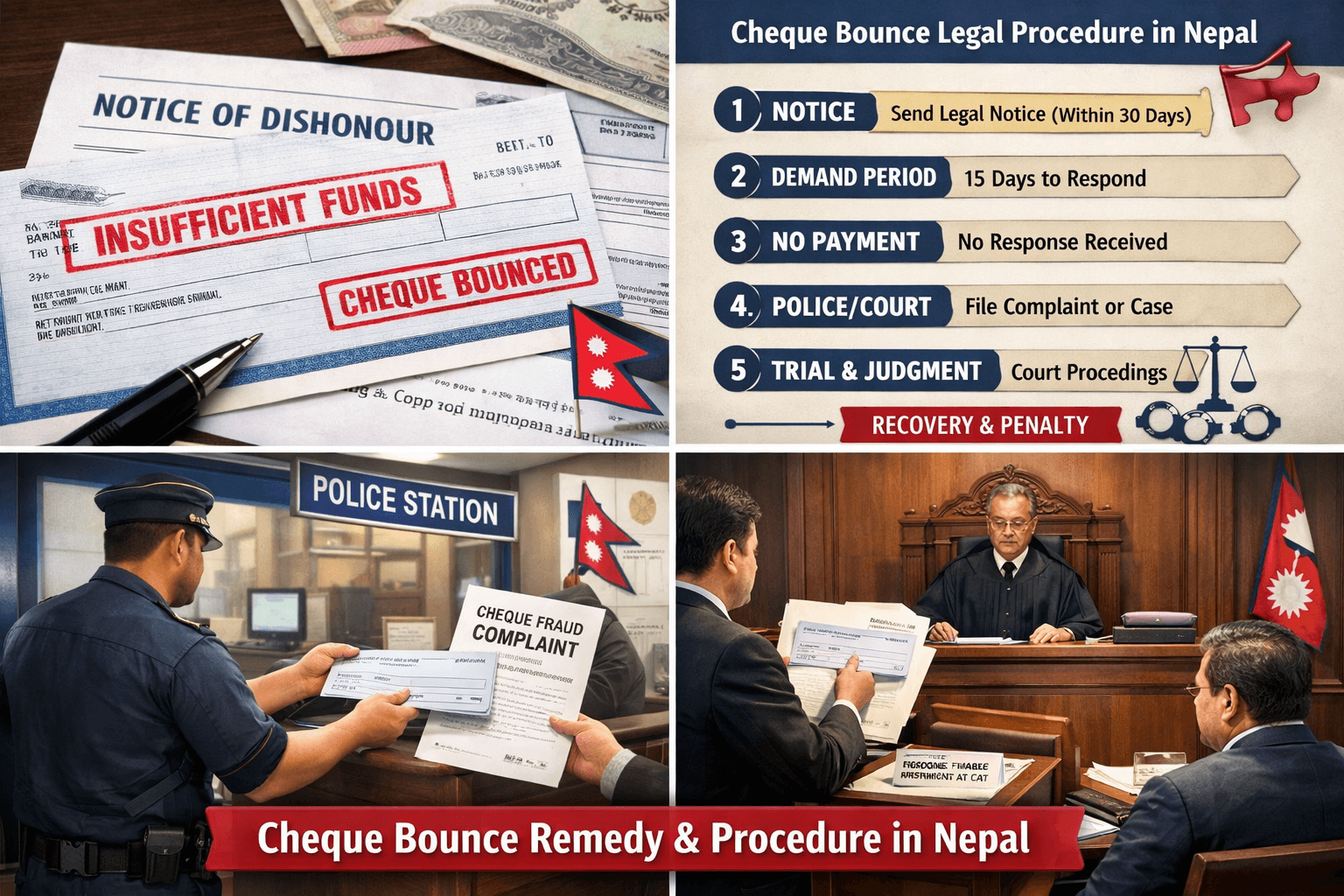
Cheque Bounce Remedy and Procedure in Nepal
This article explains the relevant provisions and available remedies in case of cheque bounce/dishonor of cheque in Nepal.
Article
Introduction
A cheque is said to be bounced when a bank refuses to make payment against a cheque due to various reasons like insufficient funds, overwriting, mismatch of signature, expired cheque, or a court order prohibiting payment. Cheque bounce is legally recognized as dishonor of a cheque in Nepal.
Laws governing Cheque bounce in Nepal
Negotiable Instruments Act, 2034 (1977)
The Negotiable Instruments Act, 2034 was promulgated to consolidate and amend the laws relating to negotiable instruments such as promissory notes, bills of exchange, and cheques. It provides the foundational framework for civil liability arising from the dishonor of cheques in Nepal. But the amendment of this Act in 2082 repealed the provision to file cheque bounce case in issue arising out of insufficient balance
Banking Offence and Punishment Act, 2064 (2008)
The Banking Offence and Punishment Act was enacted to address criminal offenses related to banking transactions. This Act aims to maintain trust in the banking and financial system by criminalizing acts such as issuing cheques without sufficient funds, thereby providing for criminal prosecution and stringent punishment for cheque bounce.
Negotiable Instruments Act, 2034
The Negotiable Instruments Act provides for civil proceedings in relation to remedies against the dishonor of a cheque. The aggrieved party has the option to initiate a civil suit under this Act.
Remedy under Negotiable Instruments Act, 2034
Under this Act, the holder of a dishonored cheque can claim the principal amount along with interest and costs.
| S.N. | Conditions for Cheque Bounce | Remedy/Penalty for Cheque Bounce |
|---|---|---|
| 1 | A cheque is considered dishonored if the drawee (bank) returns it unpaid because the amount of money standing to the credit of the drawer (issuer) is insufficient to honor the cheque, or if it exceeds the amount arranged to be paid from that account by an agreement with the bank. Other grounds include discrepancies in signature, material alterations, or the cheque being post-dated or stale. | In a civil suit under this Act, the court may order the drawer to pay the principal amount of the cheque along with interest (typically at the prevailing bank rate or as deemed reasonable by the court) and costs of the suit. Imprisonment is not a remedy under this Act. |
Case Proceeding under Negotiable Instruments Act, 2034
The legal process prescribed by the Negotiable Instruments Act to address the issue of cheque bounce involves the following steps:
Step 1: Filing of Statement of Claim at the Concerned District Court
The aggrieved party (payee or holder in due course) must file a statement of claim in the District Court having jurisdiction within five years of cheque bounce.
Step 2: Response of the Defendant at the Concerned District Court
The defendant (the issuer of the bounced cheque) must file a written statement of defense responding to the claims.
Step 3: Witness Examination and Collection of Evidence
Both the parties present witnesses and documentary evidence to substantiate their respective claims.
Step 4: Final Hearing and Decision from the Court
The judge considers all evidence and arguments before passing a judgment, which may decree the suit in favor of the plaintiff.
Step 5: Appeal to High Court (If any)
If any party is dissatisfied with the final judgment of the District Court, they have the right to appeal to the relevant High Court.
Step 6: Execution of Decision
The execution of the decision involves enforcing the court’s judgment. The winning party may file for execution if the losing party does not comply voluntarily.
Banking Offence and Punishment Act, 2064
The Banking Offence and Punishment Act provides for criminal proceedings. Under this Act, cheque bounce is treated as a criminal offense where the state, through the Government Attorney, prosecutes the accused.
Remedy under Banking Offence and Punishment Act, 2064
| S.N. | Conditions for Cheque Bounce | Penalty for Cheque Bounce |
|---|---|---|
| 1 | If a person knowingly issues a cheque without having sufficient funds in their bank account to cover the full amount, or if the cheque is dishonored for any reason with the intent to defraud, it constitutes an offense under this Act. | The court shall order the offender to pay the principal amount of the cheque to the victim. Additionally, the offender is liable to a fine equal to the amount mentioned in the cheque and may face imprisonment as per the amount in dispute. |
Case Proceeding under Banking Offence and Punishment Act, 2064
Step 1: Registration of First Information Report (FIR) at the concerned Police Office
The aggrieved party (victim) must register a First Information Report (FIR) at the relevant police office. According to the Act, the time limitation for filing an FIR is one year from the date of the cheque bounce.
Step 2: Issuance of Arrest Warrant and Arresting the Concerned Person
Based on the FIR, if there is sufficient ground, the court may issue an arrest warrant, and the police will arrest the accused to initiate the investigation.
Step 3: Investigation and Submission of Investigation Report to District Attorney
The police conduct an investigation, gather evidence, and prepare an investigation report. This report is submitted to the District Government Attorney Office for further action.
Step 4: Filing of Charge Sheet at the Concerned District Court by District Attorney
Upon reviewing the investigation report, the Government Attorney files a charge sheet against the accused in the District Court, which has jurisdiction over such offenses.
Step 5: Bail Hearing at District Court
After the charge sheet is filed, the accused appears before the court for a bail hearing, where the court decides whether to grant bail based on the nature and gravity of the offense.
Step 6: Witness Examination and Collection of Evidence
The court proceeds with the trial, which includes the examination of witnesses presented by both the prosecution and the defense.
Step 7: Final Decision
The judge delivers a final verdict. If the accused is found guilty, the court imposes punishment as prescribed under the Act.
Step 8: Appeal to High Court (If any)
If any party is dissatisfied with the District Court’s decision, they have the right to appeal to the High Court.
Step 9: Execution of Decision
After the final verdict, the decision is executed. This includes recovering the fine and the principal amount ordered to be paid to the victim.
Punishment for Cheque Bounce under the Banking Offence and Punishment Act, 2064
If the dishonor of the cheque is proven, the account holder who issued the cheque shall be required to pay the holder the amount equivalent to the cheque value, along with interest on that amount as per the prevailing law from the date of issuance of the cheque until the date of payment. Additionally, the account holder who issued the cheque shall be liable to a fine of five percent of the cheque amount and imprisonment as provided below.
- Up to 15 Lakh up to one month imprisonment
- 15 Lakh to 50 lakh 1-3 month imprisonment
- 50 Lakh to 1 Crore 3 month to 1 year imprisonment
- 1 Crore to 10 Crore 1-2 years imprisonment
- 10 Crore+ 2-4 years of imprisonment
Conclusion
The issues related to cheque bounce have significantly increased in Nepal. Both the payee and the issuer of a cheque must be sufficiently aware of the dual legal consequences—civil and criminal—that arise from the dishonor of a cheque in Nepal.
Disclaimer: This article is for informational purposes only and shall not be construed as legal advice, advertisement, personal communication, solicitation or inducement of any sort from the firm or any of its members. The firm shall not be liable for consequences arising out of any action undertaken by any person relying on the information provided herein.
Frequently Asked Questions
- What is a cheque bounce in Nepal?
- Which laws govern cheque bounce in Nepal?
- What penalties can be imposed for a cheque bounce in Nepal?
- What are the steps for civil proceedings under the Negotiable Instruments Act?
- What is the Cheque Bounce case process in Nepal?
- How is a Cheque Bounce case decided?
- What is the maximum imprisonment for cheque bounce under the Banking Offence and Punishment Act?
Need Help With This Topic?
Share your situation with our team and get practical legal guidance aligned with your objectives.
Book ConsultationBrowse Publications