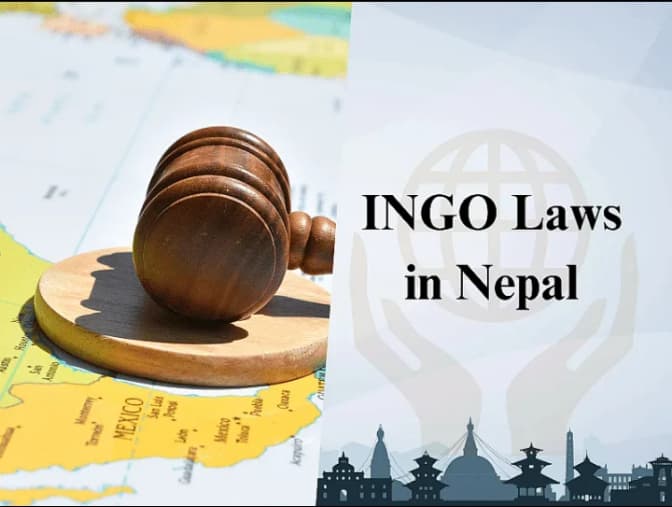
Law Governing INGOs in Nepal/INGO Registration and Operation
An outline of the legal framework for INGO registration and ongoing operations in Nepal, including compliance and reporting considerations.
Article
1. Introduction
This article outlines the laws governing International Non-Governmental Organizations (INGOs) in Nepal. It explains the procedures related to approval, registration, and operation of INGOs within the country.
2. Law Governing INGOs in Nepal
2.1. What are the laws governing INGOs in Nepal?
The primary laws governing INGOs in Nepal are:
- Social Welfare Act, 1992 (2049 B.S.)
- Social Welfare Rules, 1992 (2049 B.S.)
Besides the Act and the Rules, the Social Welfare Council has adopted various guidelines to regulate INGOs, which are updated periodically. Key guidelines include the Guidelines for General Agreement, Service and Facilitation, Guidelines for Project Agreement Appraisal, and Guidelines for Monitoring and Evaluation. The Social Welfare Council-Foreign Aid Acceptance Directives, 2071 is also a key regulatory framework.
3. Main Regulating Authority
The Social Welfare Council (SWC) is the main regulatory body responsible for regulating INGOs in Nepal. It was established under Section 5 of the Social Welfare Act, 1992. For project approval, INGOs may also need recommendations from the concerned Line Ministry.
4. Is SWC approval mandatory for INGOs?
Yes, it is compulsory to take approval from the SWC to operate INGOs in Nepal. Along with the approval, a General Agreement and a Project Agreement must be executed with the SWC before conducting development, social, or welfare activities in Nepal.
5. Major Agreements Required
The major agreements required for the operation of INGOs are:
- General Agreement (GA)
- Project Agreement (PA)
6. What is a General Agreement (GA)?
The GA is the main agreement that provides the basis for the operation of an INGO in Nepal. It is a bilateral agreement executed between the INGO and the SWC. It is entered for a certain period (typically a minimum of 3 years and a maximum of 5 years) and must be renewed after the expiry of that time period.
The GA commonly incorporates:
- Sectors/areas: Where the INGO intends to provide support in Nepal
- Minimum funding: The minimum amount of funds per annum to be used for projects
- Office setup: Provisions for establishing an office in Nepal
- Reporting & compliance: Ongoing reporting and compliance requirements
7. What is a Project Agreement (PA)?
The PA is a tripartite agreement executed between the INGO, the SWC, and the local partner NGO for the implementation of specific projects in Nepal.
The PA incorporates:
- Background: Context and rationale for the project
- Objectives: Project goals and intended outcomes
- Methodology: Implementation approach
- Monitoring plan: Monitoring and evaluation commitments
- Budget: Budget estimate and funding details
- Roles & responsibilities: Duties of each party for the project
8. When should an INGO submit the application for a Project Agreement?
The application for the PA needs to be submitted within 3 months from the date of signing the General Agreement. If an INGO is unable to do so within that time, the SWC may provide an additional 3 months for submission. A fine of USD 1,000 will be charged if the submission is not made within the extended period, and failure to do so may invalidate the General Agreement.
9. How many Project Agreements can be concluded under one General Agreement?
INGOs can conclude more than one Project Agreement under a single General Agreement.
10. Minimum funding commitment
INGOs are generally required to commit a minimum of USD 200,000 per annum for their projects in Nepal. The source of funds for INGOs must come from outside of Nepal.
11. Requirement to work through local partners
INGOs cannot implement projects directly by themselves. Projects must be implemented through local partner organizations. These local partners include:
- Non-Governmental Organizations (NGO)
- Companies Not Distributing Profits
- Any registered entity established with a non-profit objective
The local partner should generally have a minimum work experience of two years. If a qualified partner is not available in the project district, preference is given to zonal, regional, and then central-level partners. In such cases, a local sub-partner should be selected and capacitated within one year of the project's start date.
12. Local office requirement and legal status
An INGO is required to set up a local office for its operations in Nepal.
The local office will not have independent legal status or corporate personality separate from the parent INGO. It remains a part of the foreign INGO in terms of authority and function.
The local office of the INGO must also be registered with the tax authority in Nepal (Inland Revenue Department) to obtain a Permanent Account Number (PAN).
13. Documents required for approval of a General Agreement
Along with the application, the following documents must be submitted by an INGO:
- Certificate of Registration: From the home country
- By-Laws (Approved Constitution): Of the parent organization (with notarized English translation if needed)
- Objectives document: If by-laws do not clearly state objectives, an additional authentic document explaining them
- Proof of Financial Commitment: Minimum USD 200,000 per annum
- Concept paper / project proposal: Initial proposal or concept note
- Draft General Agreement: In the prescribed format
- Letter of Authorization: To deal with agreement business
- Authorized person details: Copy of passport, valid visa, and bio-data (e.g., Country Director)
- Covering letter: Formal submission letter
- Funding source evidence: Evidence of reliable funding sources substantiating the minimum funding commitment
- Latest audit report: Of the parent organization
14. Restriction on profit-oriented business activities
INGOs are generally restricted from making any share investments in profit-oriented institutions with the intention of carrying out business in Nepal. Their funds must be used for stated non-profit objectives.
15. Restriction on administrative costs
INGOs cannot spend more than 20% of total funding on administrative costs. At least 80% of the budget must be allocated for project implementation.
16. Financial assistance to local partners
It is not necessary for the INGO to obtain separate approval to merely provide financial assistance to a local partner. However, the local partner NGO must obtain approval from the SWC before receiving and utilizing such financial assistance.
17. Filing and reporting compliances
INGOs are required to:
- Audit report: Submit an audit report to the SWC within six months of the fiscal year's end, along with a detailed description of work and activities
- Six-month reporting: Report activities every six months
- Annual report: Submit an annual report detailing administrative and program costs
- Annual audit: Ensure annual audits are conducted by a registered chartered accountant in Nepal
18. Consequences of non-compliance
Non-compliance with the General and Project Agreements may result in:
- Blacklisting
- Invalidation of the General Agreement
- Cancellation of work permits and visas for INGO representatives
- Fines: For example, USD 2,000 for desiring to enter into agreements after initially failing to perform
- Suspension/freezing: Suspension of affiliation or freezing of bank accounts
19. Frequently Asked Questions
- What are the main laws governing INGOs in Nepal?
- What is the main authority regulating INGOs in Nepal?
- Is SWC approval necessary for INGOs to operate?
- What agreements are required for INGOs to operate in Nepal?
- What is a General Agreement (GA)?
- What is a Project Agreement (PA)?
- Is there a minimum donation amount required for INGOs?
- What documents are required for a General Agreement in Nepal?
Need Help With This Topic?
Share your situation with our team and get practical legal guidance aligned with your objectives.
Book ConsultationBrowse Publications