
Foreign/Abroad Citizens Court Marriage in Nepal under Nepalese law.
An overview of the court marriage process in Nepal for foreign and abroad citizens, including key legal steps and common requirements.
Article
1. Introduction: Court Marriage for Foreigners in Nepal
Nepal has become a preferred jurisdiction for international couples seeking a legally recognized union. Foreign citizens can legally solemnize a court marriage in Nepal under the provisions of the National Civil Code, 2017 (Muluki Civil Code 2074). Nepal permits both marriages between two foreign nationals and marriages between a Nepali citizen and a foreign citizen.
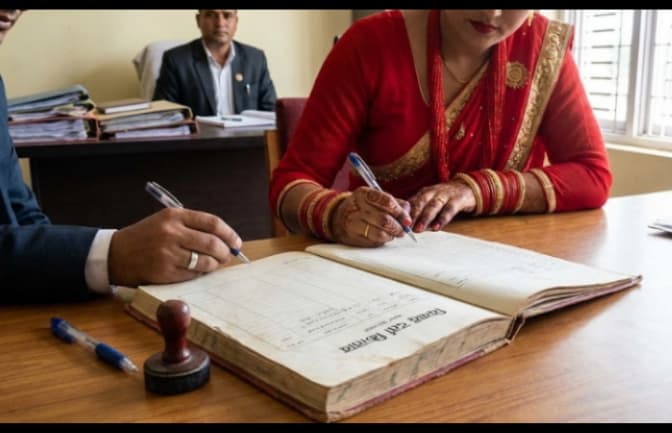
The marriage registration process is judicial and takes place before the District Court having jurisdiction over the area where the foreigner has been residing. The process involves legal eligibility verification, submission of authenticated documents, and formal registration before a judge. The marriage certificate issued by the District Court serves as the official legal document in Nepal.
2. Legal Framework Governing Court Marriage in Nepal
Court marriage for foreign nationals is regulated by the following laws:
- National Civil Code, 2017 (Muluki Civil Code 2074): Sections 67 to 84 govern marriage provisions, including eligibility, consent, prohibited relationships, and the registration procedure.
- Immigration Act, 1992 (2049 BS): Governs visa and stay requirements for foreign nationals in Nepal.
- National Civil Procedural Regulation, (2075): It inlcudes rules, format of marriage application form and marriage certificate.
3. Types of Court Marriage Available to Foreign Citizens
3.1. Marriage between Two Foreign Nationals
Two foreign nationals residing in Nepal may solemnize marriage before the District Court. Both individuals must prove their legal capacity to marry under Nepalese law and confirm that their personal law does not prohibit the union. The court verifies age, marital status, free consent, and the absence of prohibited relationships.
3.2. Marriage between Nepali Citizen and Foreign Citizen
A Nepali citizen can marry a foreign national before the District Court. The foreign party must obtain a temporary residence certificate or other documentation confirming their legal stay in Nepal. This type of marriage may affect the visa and immigration status of the foreign spouse.
4. Eligibility Criteria for Court Marriage in Nepal
The following legal requirements apply under Section 70 of the National Civil Code 2017:
- Age: Both parties must be at least 20 years of age. While some sources mention 21 for males and 20 for females, the Muluki Civil Code 2074 specifies 20 years for both. It is best to confirm with the specific District Court, as procedural directives can sometimes vary.
- Consent: Both must give free and voluntary consent.
- Marital Status: Neither party should have a living spouse (monogamy is the rule).
- Prohibited Relationship: Parties must not fall within prohibited degrees of relationship (close blood relations).
- Mental Capacity: Parties must possess sound mental capacity to consent.
If either party is previously married, they must submit a legally recognized divorce decree or the death certificate of the former spouse.
5. Required Documents for Foreign Citizens' Court Marriage in Nepal
The District Court requires the submission of authenticated documents. All documents not in English or Nepali must be translated into Nepali and notarized.
Documents required from foreign national(s):
- Valid Passport: Original and copy. Must be valid for the entire duration of the process.
- Valid Visa: Proof of legal stay in Nepal (tourist, work, or other visa).
- Single Status Certificate / No Objection Letter (NOC): Issued by the Embassy/Consulate of the foreign national in Nepal. Confirms the person is legally free to marry (unmarried, divorced, or widowed).
- Birth Certificate: Original or certified copy, with Nepali translation if required.
- Residence Certificate: Issued by the local Ward Office, confirming the foreigner has resided in Nepal (often required to be at least 15 days).
- Divorce Decree / Death Certificate: If applicable. Must be authenticated and translated.
- Passport-sized Photographs: Several copies as required by the court.
- Witnesses: Two witnesses with valid citizenship documents (for Nepali citizens) or passports (for foreigners).
6. Process for Court Marriage in Nepal
Step 1: Meet the Minimum Stay Requirement
Foreign nationals must have resided in Nepal for at least 15 consecutive days before filing the marriage application. This is a strictly enforced mandatory condition.
Step 2: Obtain Necessary Embassy Documents
Visit your country's embassy in Kathmandu to obtain a “No Objection Certificate” or “Affidavit of Eligibility to Marry,” which confirms your single status and legal capacity to marry.
Step 3: Document Preparation and Verification
All foreign documents must be notarized and officially translated into Nepali.
Step 4: File Application at District Court
A joint application for marriage registration must be filed by both parties at the District Court (usually the Kathmandu District Court or the court in the district of residence).
Step 5: Court Review and Publication of Notice (if applicable)
The court verifies the documents. While a 15-day public notice period was a common requirement, some courts may proceed faster if all documents are in order. Consult the specific court or a lawyer about current practice.
Step 6: Court Appearance
Both parties must appear physically before the judge. The judge records statements from both parties and their witnesses to confirm free consent and identity.
Step 7: Marriage Registration and Certificate Issuance
If the judge is satisfied with all requirements, the marriage is officially registered, and a Court Marriage Certificate is issued, often on the same day or the next working day.
7. Recognition of Nepalese Marriage and Post-Marriage Formalities
7.1. International Recognition
A marriage registered in Nepal is legally valid. However, for use abroad, the certificate must be authenticated.
- Apostille: Nepal is not a member of the Hague Apostille Convention, so it does not issue Apostille stamps.
- Legalization: The certificate must be legalized by Nepal's Ministry of Foreign Affairs (MOFA) and then by the embassy of the country where it will be used.
7.2. Immigration and Citizenship for Foreign Spouse
Marriage to a Nepali citizen does not automatically grant Nepali citizenship.
- Visa: The foreign spouse may apply for a Residential/Family Visa (Non-Tourist Visa) from the Department of Immigration based on the marriage.
- Citizenship: A foreign woman married to a Nepali man can apply for naturalized citizenship. As per recent amendments, she must have resided in Nepal for a continuous period (often proposed as seven years after marriage). The path to citizenship for a foreign man married to a Nepali woman is generally more restrictive.
8. Special Considerations
- Same-Sex Marriage: Statutory codification is still developing and registration may vary by administrative practice. Consult the District Court for the most current guidelines.
- Legal Assistance: Due to documentation requirements and potential language barriers, hiring a local lawyer is highly recommended to avoid procedural delays.
9. Conclusion
Foreign citizens can legally solemnize a court marriage in Nepal under the National Civil Code 2017. The process requires meeting eligibility criteria, preparing authenticated documents, completing a minimum 15-day stay, and appearing before a District Court judge. While the Nepali marriage certificate is valid, international recognition depends on legalization through MOFA and the relevant embassy. Legal assistance is recommended to ensure a smooth and compliant process.
Need Help With This Topic?
Share your situation with our team and get practical legal guidance aligned with your objectives.
Book ConsultationBrowse Publications